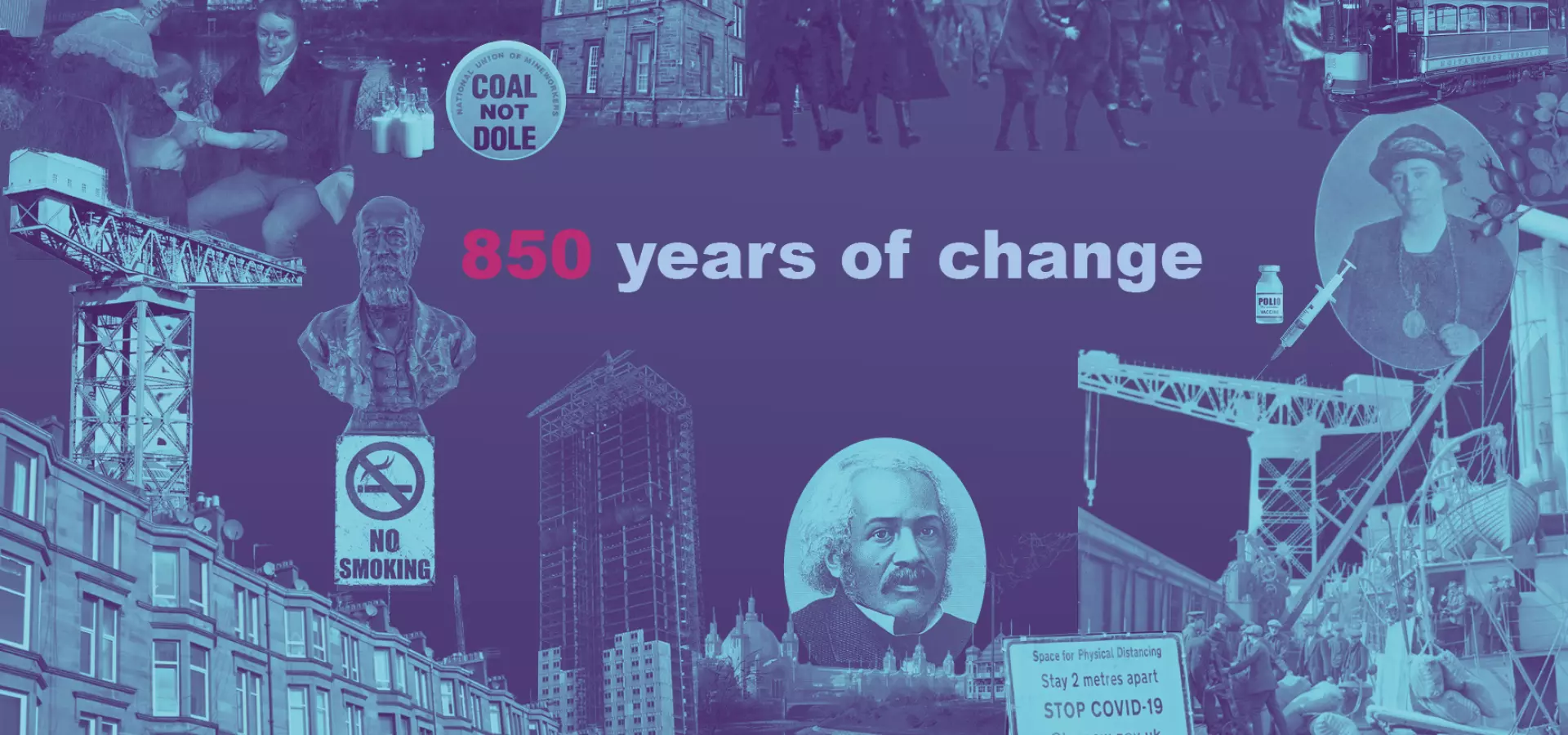
The people who made Glasgow
Acting GCPH Communications Officer, Kelda McLean, reflects on the newly published timeline of Glasgow’s Health History, which was compiled to mark Glasgow’s 850th anniversary this year.
Glasgow's health history timeline is a project that has been produced as a way to mark Glasgow’s 850th anniversary, while also advancing our 'knowledge translation' approach. The timeline highlights some of the important milestones (and stepping stones) in Glasgow’s ‘health history’ and draws on insights from a range of existing GCPH publications, including the 2016 report History, Politics and Vulnerability: Explaining excess mortality in Scotland and Glasgow.
The timeline aims to bring together GCPH’s knowledge and understanding of the factors that have shaped Glasgow’s health over time. By presenting this in an accessible format, we hope that this will further deepen our awareness of the lessons from the past and their relevance to present and future challenges.
What the timeline shows
Beginning in the year 1175AD (the year that King William I of Scotland issued a charter granting Glasgow the status of a burgh), the timeline charts changes that were seen across many Western countries, in following the described four “waves” of public health development. Also shown is how public health in Glasgow and Scotland, as well as the UK and globally, has had a long history of debates, controversies, successes and failures. The timeline addresses a common misconception that public health has developed along a ‘linear trajectory’ when, in fact, many ideas, interventions and improvements in relation to the ‘building blocks of health’ were either fought for by individuals and collectives (such as unions or charitable organisations) or arose after protracted and contested debates.
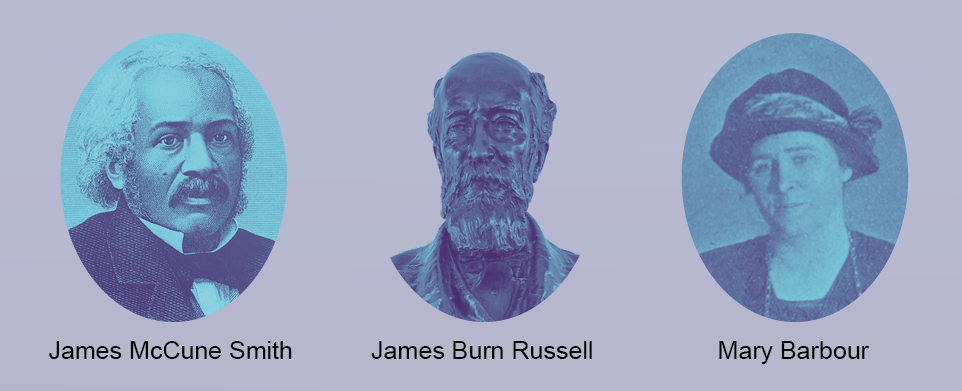
While working on the timeline, what also became clear was the interplay between social, economic and technological forces, and how individual and collective action have shaped responses to these changes and influences. This can be illustrated through the lives of three notable Glaswegians: Dr James McCune Smith, Dr James Burn Russell, and Mary Barbour, each of whom played a transformative contribution in Glasgow’s long pursuit towards better health.
Dr James McCune Smith
Dr James McCune Smith (1813–1865) was an African American medical doctor, abolitionist, and scholar who studied at the University of Glasgow after being denied entry to American universities due to racial discrimination. He became the first African American to earn a medical degree, graduating in 1837. McCune Smith’s education in Glasgow gave him the tools to challenge slavery and racism with the language of science and reason. Shortly after graduating he worked at Glasgow’s infamous Lock Hospital for women with sexually transmitted infections, where he challenged what he saw were unethical and unscientific treatments. Later, he became one of the leading intellectuals of the abolitionist movement, using a combination of medicine, statistics, and moral argument to expose the social roots of inequality and showed that structural injustice (whether of slavery, poverty, or medical exploitation) could be confronted using both evidence and a sense of moral conviction.
Dr James Burn Russell
Rutherglen-born Dr James Burn (JB) Russell (1837-1904) applied a similar belief in the power of evidence and science to transform public health in Glasgow. As the city’s first full time Medical Officer of Health, he used data, observation, and moral conviction to tackle disease and overcrowding. In 1888 he produced a publication entitled "Life in One Room" about the serious public health issues of overcrowding, associated with one-roomed dwellings (or ‘single ends’) in the city. He used this evidence to promote public health reforms, which included the provision of clean water, sanitation systems, and housing inspection.
Mary Barbour
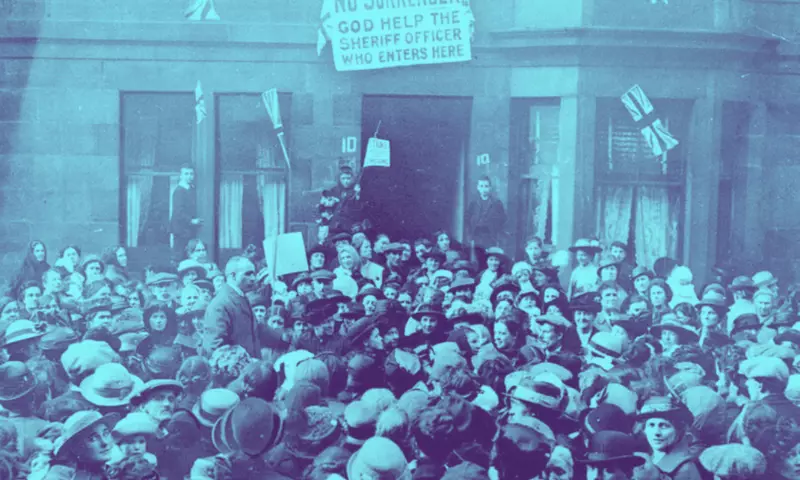
Mary Barbour (1875-1958) was an activist who took the ideals of health and human dignity from the realm of policy and expertise into the streets and tenements of Govan. She mobilised working-class families, particularly women, during the 1915 Glasgow Rent Strikes to demand fair rents and better housing. Her leadership contributed to the implementation of the Rent Restriction Act 1915, which froze rents across the UK at their pre-war levels. Later, as a Glasgow Councillor, she continued her work to improve the lives of the people she represented, and to champion public health and social welfare, serving on many committees. Among her initiatives were free school milk, children’s play areas, municipal washhouses, and the establishment of Glasgow’s first family-planning clinic.
Collective legacies
Together, the lives and works of these three people can be used to chart Glasgow’s journey from enlightenment and emancipation, through civic and public health reform, to grassroots empowerment. Specifically, it has been interesting to see the linkages between the ideals of Dr James McCune Smith, who argued that freedom and justice were inherent rights, to Dr JB Russell, who demonstrated that decent living conditions were the foundation of a civilised city, and to Mary Barbour, who furthered these principles through grassroots activism and political courage.
For me, these life-stories from the past have shown how Glasgow’s health outcomes have been shaped by a dynamic interaction between people, places and institutions. They serve as a powerful reminder that each of us has a role to play in collectively shaping our city’s present and future.
Photo: Glasgow rent strike picket in Govan, 20th October 1915 (Wikimedia Commons)

 Previous