A public health evaluation of Community Wealth Building (CWB) in Scotland
In this guest blog, Dr Jayne Galinsky, Research Fellow at the Yunus Centre for Social Business & Health, Glasgow Caledonian University, talks about the new CoWBELLS project: Community Wealth Building Evaluation: Learning Lessons from Scotland.
Community Wealth Building (CWB) is an approach to economic development that focusses on keeping wealth within local communities. Instead of money being spent outside local communities, this model prioritises supporting local businesses, promoting fair employment, and increasing community ownership. The goal of CWB is to ensure that collective wealth serves people and their communities more effectively. CWB aims to boost incomes and improve job security, strengthen local economies, and increase community control over local assets. By reducing poverty and deprivation and helping create healthier, more sustainable environments, CWB seeks to ensure that the benefits of economic activity are retained and shared within communities.
In 2015, Preston, a city in the north of England, began implementing CWB – aiming to transform procurement policies to support local supply chains, improve local employment conditions and wages, and increase socially productive use of assets (such as turning vacant and derelict property into social housing and building local employment and skills plans into housing development planning). Researchers studying CWB in Preston compared trends in mental health outcomes before CWB (2011–2015) and after its implementation (2016–2019), and found that the CWB was associated with reductions in the prescribing of antidepressants in Preston and the number of people with depression. People in Preston also saw a 9% boost in life satisfaction and an 11% rise in median wages.
In 2020, the Scottish Government put its support behind Community Wealth Building, with North Ayrshire being the first implementation site, before expanding it to a further five pilot areas across the country – setting the stage for a nationwide rollout. In February 2026, the Community Wealth Building Bill was passed by the Scottish Parliament. This new Bill sets out a clear framework requiring public bodies and local authorities to put community‑focussed economic practices at the heart of what they do. With it, Scotland becomes the first country in the world to embed CWB as a national policy.
CWB is important in Scotland, where health and income inequalities are amongst the widest in Europe, with differences in life expectancy, poverty, and health outcomes between its most and least deprived communities. Data on wealth inequality in Scotland (assets, savings, property) show that the wealthiest 2% of households hold 15% of all wealth. Recent statistics are striking – people under 75 years in Scotland’s 20% most-deprived areas are more than three times more likely to die early compared to the 20% least-deprived areas. Scotland’s implementation of CWB seeks to tackle these inequalities by helping local economies keep and grow more of their own wealth which in turn, and in the longer term, may support better health outcomes.
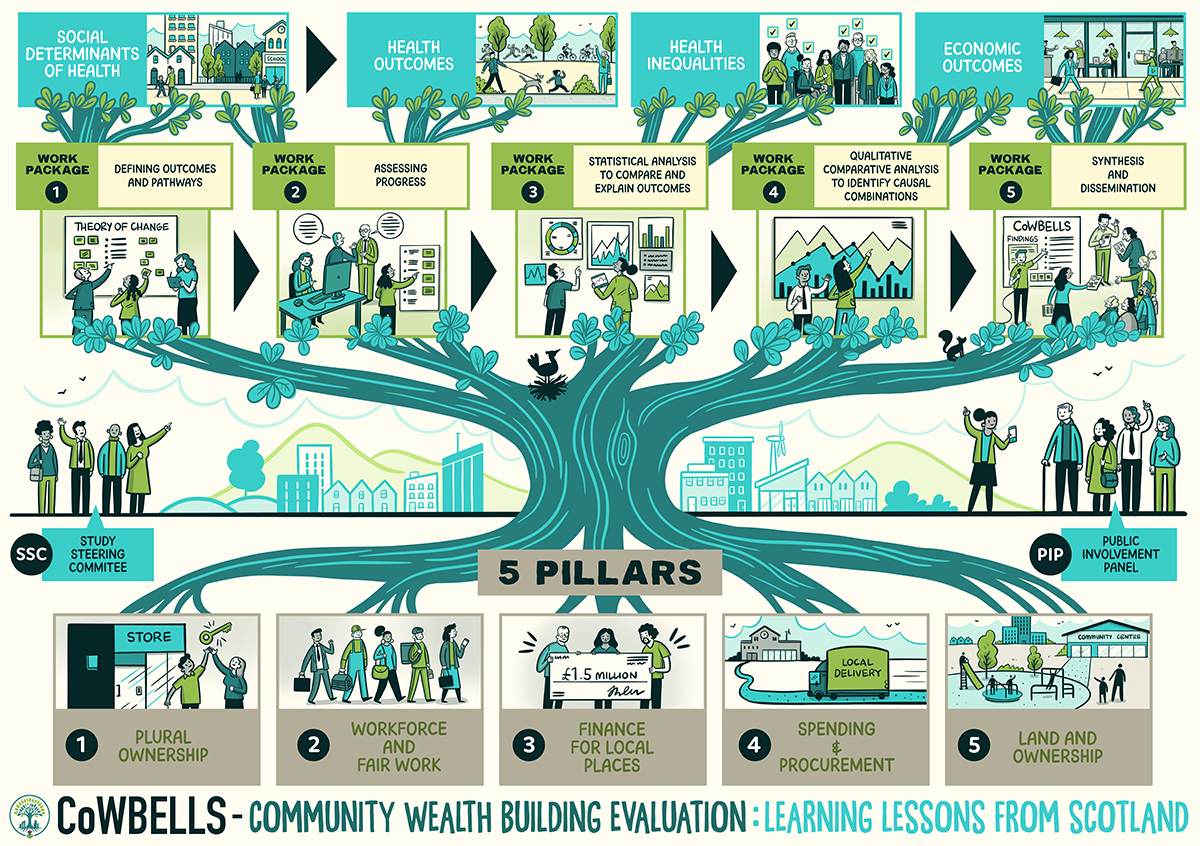
Our study, CoWBELLS – Community Wealth Building Evaluation: Learning Lessons from Scotland – is a three year mixed method evaluation of the impact of CWB on economic and health outcomes and health inequalities. The CoWBELLS project is funded by the National Institute for Health Research (NIHR) and led by Glasgow Caledonian University, working in partnership with the Glasgow Centre for Population Health (GCPH), the University of Glasgow and Lancaster University. The study is made up of different work packages, each designed to answer different research questions within the project.
The specific research questions for CoWBELLS are:
- What are likely to be the most effective pathways for CWB to improve population health and reduce health inequalities?
- How has CWB been implemented in Scotland and how does it vary across local authorities?
- What are the barriers and facilitators to the implementation of CWB?
- What is the effect of CWB on health and intermediate economic outcomes?
- What has been the impact of CWB on inequalities in health across groups defined by their individual or household social position?
- What is the contribution of different components of Community Wealth Building to economic and health outcomes and does the impact vary with the degree of implementation?
The progress of our study will be overseen by our Study Steering Committee, with support and input from our Public Involvement Panel (PIP), facilitated by Glasgow Centre for Population Health.
You can find out more about the study, who is involved, and the research on the CoWBELLS website: www.cowbellsstudy.com

 Previous