Community Wealth Building Evaluation: Insights from communities across Scotland
As part of the Community Wealth Building Evaluation: Learning Lessons from Scotland (CoWBELLS) project, GCPH has brought together a group of 14 people from community‑led organisations, small businesses and social enterprises across Scotland to form a Public Involvement Panel (PIP) to advise and ensure that the expertise and perspectives of those involved in local community wealth building (CWB) implementation across Scotland shape and inform the project.
The organisations represented on the PIP are based across the six local authority areas who have been piloting CWB before the CWB Bill was passed in February 2026 for national implementation. These pilot areas include North Ayrshire, Clackmannanshire, South of Scotland, Western Isles, Fife and Glasgow City.
We invited staff and volunteers from social enterprises, small businesses and community-led organisations to join the PIP, due to their knowledge and expertise of their local communities and direct experience of delivering CWB activities. This hands-on experience brings rich insights into how CWB really works ‘on the ground’ and what local factors shape implementation – what makes it work, and what gets in the way. This lived experience is essential for CoWBELLS as we try to understand how CWB affects health and economic outcomes, and importantly, keeps us from making assumptions about what CWB looks like in real life.
Our approach to the CoWBELLS PIP is modelled from learning from the delivery and evaluation of previous Public Involvement Panels for CommonHealth Assets (CHA) and CommonHealth Catalyst (CHC), with guidance from the National Standards for Community Engagement and What Works Scotland Public Engagement Handbook.
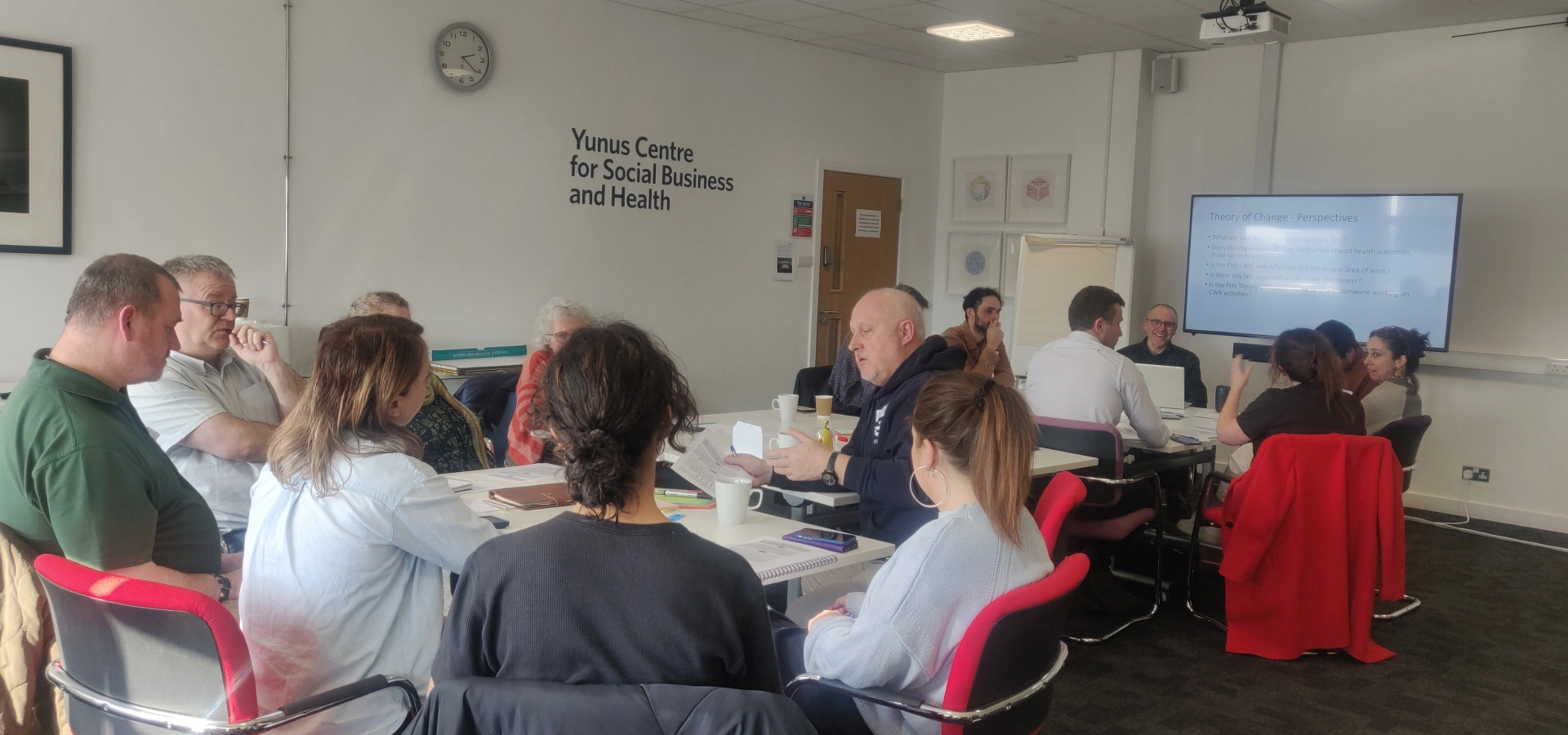
Since the project began in October 2025, the PIP has met twice – firstly online in February 2026 for introductions and to hear an overview of the project, and then in March for full day in-person meeting at Glasgow Caledonian University.
The PIP brings together representatives from SHAX Charity shop, BRAG Enterprises, Glenkins Community and Arts Trust, Gingerbread Fife, Cumbrae Aspires, Maslow’s Community, the Usual Place, the Stove Network, Social Enterprise Accountancy, Bùth Bharriagh, An Taigh Cèilidh and Uig Development Trust. Together these organisations are working across the five pillars of CWB to help keep wealth and resources within their local areas.
Just like in the CHA and CHC Panels, we designed our first in-person meeting to be highly participatory, splitting up the day into four group activities each related to the projects current Work Packages. We began by creating a ‘working together agreement’ to set shared expectations from the outset of how we wanted to work together.
The first activity invited PIP members to reflect on their own contributions to CWB, while helping the research team to better understand how CWB is being implemented in each local authority area. Interestingly, there was limited awareness of existing CWB activities in their areas, and specific challenges linked to implementation of the pillars were raised. For example, some members shared how difficult the Inclusive Ownership pillar can be to put into practice due to the lack of resource and support available for acquiring community assets – funding may have restrictions on who can access this and may not offer longer term support for maintaining assets, which can leave communities struggling with ongoing upkeep.
On the other hand, positive examples of CWB in action included the availability and use of community banking options in North Ayrshire following the closure of commercial banking branches, and strong Fair Work principles being adopted by community organisations.
The second activity focused on Work Package 1 and invited the PIP to share their thoughts on the project’s developing Theory of Change. This theory details how CWB is expected to impact on health and economic outcomes, including pathways to change, as well as the factors which may help or hinder progress. The theory is being developed by building on previous work from Public Health Scotland through iterative workshops with stakeholders and the PIP, and will be used throughout the project to test the real-world impact of CWB using the research data.
The third activity focused on Work Package 2, which will involve 60-minute interviews with different stakeholders to understand how CWB has been implemented in local authority areas so far. We asked the PIP to help shape these interviews by suggesting what questions we should be asking, and who should be included in the sample. In the final activity, the PIP gave advice on which qualitative indicators would be most useful for evaluating the impact of CWB in Work Package 3.
During these discussions, PIP members raised several important concerns including differences in how the Bill is being understood, how ‘progress’ will be interpreted and assessed, and whether local context might be overlooked. There were also questions about how the third sector will be consulted, how diverse the stakeholder group will be, and how ‘community’ is defined within CWB. PIP members also felt that it was important to explore real-world experiences of local procurement including how decisions are made, where gaps exist between policy intention and implementation realities, and how much budget and resources local authorities are dedicating to CWB.
All of these insights will help to shape how the researcher team approaches data collection in the project Work Packages and next stages, ensuring that nuance is captured and the concerns of community stakeholders are addressed. To support accountability, the researcher team will also respond to the Panel’s suggestions and explain how this feedback has been used to inform key decisions and project planning. These responses will be shared with the Panel ahead of our next meeting, which is expected to take place in September.
If you are interested in finding out more about the project and the work of the PIP, you can visit the CoWBELLS website here and the GCPH webpage on Community Wealth Building for information and further resources.

 Previous