
Lessons from Glasgow’s Cash-First partnership project
Making cash-first progress without reinventing the wheel
Following on from the fourth Cash-First Communities conference this past June, and prior to the publication of the project’s summary report in August, Director of the Independent Food Aid Network Sabine Goodwin reflects on the Glasgow Cash-First Project and its learning in our latest guest blog.
The Scottish Government’s groundbreaking plan towards ending the need for food banks provided tranches of £200,000 to local partnerships working to address food insecurity through cash-first, income-focussed agendas in eight local authorities across Scotland. This was driven by Action One of the nine-point plan aiming to strengthen cash-first responses to financial hardship.
The Glasgow Fair Food for All Partnership (GFFAP) is based in a city home to 11% of Scotland’s population and over 650,000 people. 19.3% of Glasgow City’s population is income-deprived while the city hosts the highest number of asylum seekers in Scotland and, in 2022, 26% of Glaswegians reported a long-term health problem or disability. £200,000 wasn’t going to go a long way to directly boosting the incomes of tens of thousands of people struggling to afford essentials but the GFFAP’s focus on strengthening and highlighting existing local systems to ensure people can more easily find ways to maximise their incomes and, where possible, access cash-first crisis payments through the Scottish Welfare Fund, has nonetheless proved to be transformative.
Laying the groundwork of the two-year project
Glasgow’s two-year Cash-First Project took a multi-dimensional approach, identifying key factors that merited investment and evaluation. The project took on board the Glasgow City Food Plan’s Fair Food for All objectives including supporting the running of the multi-sector GFFAP; improving understanding of support pathways for people facing financial precarity; facilitating the development of cash-first approaches such as advice provision as well as referral pathways, including strengthening integration with the free and confidential signposting service Glasgow Helps; and improving access to support for people at risk while embedding lived experience into the design of local services.
What taking a cash-first approach to food insecurity means
As long-term advocates for a cash-first approach to food insecurity, IFAN explains that this means prioritising the option of cash payments over shopping vouchers or in-kind support in a crisis, helping people find routes to income maximisation and access to existing entitlements at the earliest opportunity, and promoting ways to identify local cash-first options. Cash-first interventions might include the Scottish Child Payment, the £20 uplift to Universal Credit, or cash-first crisis payments distributed by local authorities.
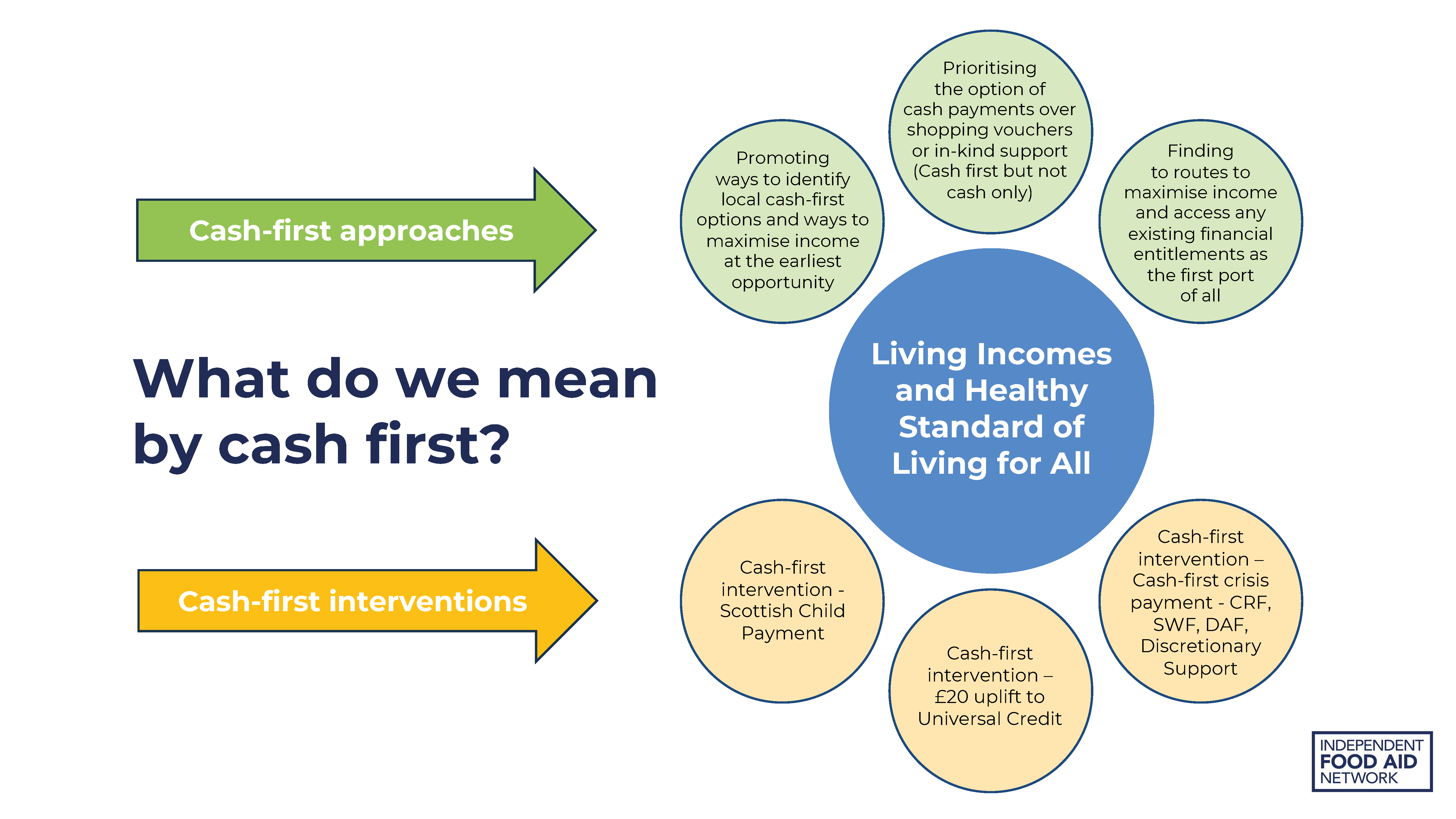
In response to what was found to be inconsistent understanding of what was meant by 'cash-first' at a grassroots level, the GFFAP developed the Cash-first approaches in Glasgow webpage via the Glasgow Centre for Population Health (GCPH) including IFAN infographics, recordings from cash-first focussed training sessions, reading material, as well as the Glasgow ‘Worrying about money?’ resources and the Glasgow Helps’ leaflet. Two standalone resources were also put together on cash-first training and awareness-raising information and as a cash-first concept explainer in the context of key public health messages. This work was highlighted in the Scottish Government’s interim evaluation on the cash-first partnership’s work.
Promoting cash-first focussed local community networks of support
The development of these resources was accompanied by work inspired by the Glasgow Community Food Network’s report on cash first in community settings that again identified the need for clarity and training in community food settings on the concept of a cash-first approach to food insecurity. As a result, eighteen training and awareness-raising sessions were organised and delivered between October 2024 and January 2026 on cash-first approaches and pathways to support. Feedback indicated these helped improve ‘confidence, consistency, and the use of dignity-based approaches across organisations’. Glasgow Helps was promoted as the main cash-first focussed referral pathway or triage system, and awareness of Glasgow’s network of local support services was heightened. This series of sessions included IFAN Money Counts training linked to the Glasgow ‘Worrying about money?’ resources.
Early intervention is key
Glasgow’s Cash-First Project also provided additional funding to the Access to Advice Service delivered in collaboration with Glasgow Helps and part of Trussell’s Pathways to Advice and Cash in Scotland. By providing flexible and responsive financial advice, this service helped clients address financial issues at an early stage. People who engaged with the service ‘reported positive outcomes, including improvements in their mental health, increased confidence in financial matters, and improved social relationships’.
Integrating the expertise of people with lived experience
The Glasgow Cash-First Project collaborated with GCFN to co-commission engagement with experts by experience based in Glasgow who had previously accessed a variety of community food initiatives to explore how cash-first support might be implemented in these settings. Various themes emerged, including the importance of choice, dignity, and community voice; the recognition that food insecurity is rooted in insufficient income, combined with a lack of access to affordable, nutritious food.
Preparing for the next cash-first steps in Glasgow
As we eagerly await the publication of the Scottish Government’s evaluation of the work of all eight Cash-First partnerships and any second plan towards ending the need for food banks, it’s clear that invaluable partnership work, like the collaborative efforts behind the Glasgow Cash-First Project, requires a sufficient level of funding and partner commitment to ensure continued impact. There’s been huge value in promoting and raising awareness of the existing Glasgow Helps service, as well as other cash-first focussed resources and training options including the Glasgow ‘Worrying About Money?’ leaflet.
Part of the bigger picture
This impactful work represents just one of eight Cash-First partnerships. In June 2026, the fourth Cash-First Communities conference in Glasgow featured the work of the Glasgow Cash-First Project along with highlights from the other eight Cash-First partnerships.
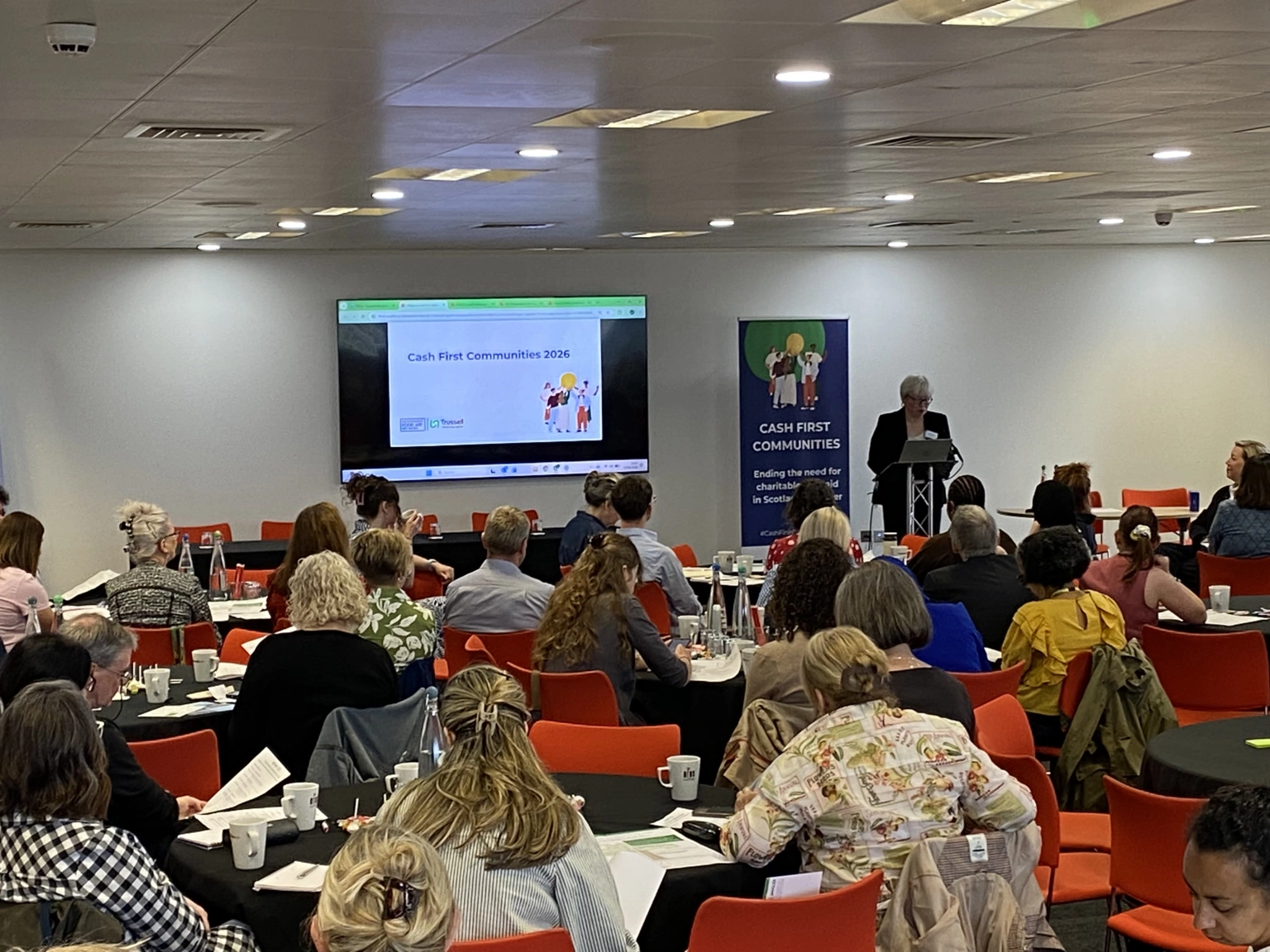
The conference also highlighted the other eight cash-first actions in the nine-point plan as well as a range of projects and interventions clearly demonstrating cash-first progress across Scotland.
Further afield, England’s new Crisis and Resilience Fund has the potential to be hugely impactful in terms of cash-first progress. The importance of working with existing partnerships, as advocated by the Glasgow Cash-First Project report, is particularly pertinent as local authorities establish cash-first crisis payments connected to financial resilience services through local community networks of support in England this summer.
Building blocks of change
Faced with the enormity of the challenge of widespread food insecurity in Scotland’s largest city, Glasgow’s Cash-First Project’s findings(1) help build the evidence base for integrating cash-first approaches and interventions into local areas, despite the reality that social security payments, asylum support, and wages are woefully inadequate. Glasgow’s Cash-First Project’s report adds to a growing body of resources, research, and expert by experience testimonies making the unequivocal case for taking a cash-first approach to food insecurity at local, national, and UK-wide level as urgently as possible.
(1) The Cash-First Project summary report will be published in August.
The UK-wide Independent Food Aid Network (IFAN) represents independent food aid providers operating in 25 local authorities in Scotland, envisions a UK without the need for charitable food aid, and has long advocated for a cash-first approach to food insecurity. IFAN has been funded by the Scottish Government to co-produce and disseminate ‘Worrying About Money?’ resources in every local authority in Scotland and is now co-producing ‘Moved to Scotland and Worrying About Money?’ resources alongside Migration Policy Scotland. IFAN is a member of the Glasgow Fair Food for All Partnership and Sabine Goodwin has been a member of the Steering Group linked to the Scottish Government’s plan towards ending the need for food banks. IFAN also took part in the DWP’s co-design process for its new Crisis and Resilience Fund guidance that requires English local authorities to distribute cash-first crisis payments and the ways and means to build financial resilience and is part of the newly formed CRF Alliance in England.

 Previous